
What New Screen-Time Policies Mean for Your Math Intervention Choice

California has now signed its own law addressing classroom screen time. SB 1128, signed by Governor Newsom this September, ends the practice of requiring kindergarten and TK students to take school-issued devices home starting in the 2027–28 school year, and directs the California Department of Education to publish model guidance on age-appropriate screen use for every grade level by July 2027.
The most visible example of a district already acting on this shift is much closer to home. In April, the Los Angeles Unified School District board voted unanimously to develop a districtwide screen-time policy for the 2026–27 school year — banning district-issued devices for students in early education through 1st grade, and capping screen time for grades 2–5 at 60 minutes a day or 300 minutes a week, including for homework. As Board Member Nick Melvoin put it, the goal isn’t to eliminate technology — it’s to “recalibrate” the relationship schools have built with it since the pandemic.
…the goal isn’t to eliminate technology — it’s to “recalibrate” the relationship schools have built with it since the pandemic.
Beyond Compliance: An Opening to Accelerate Math Achievement
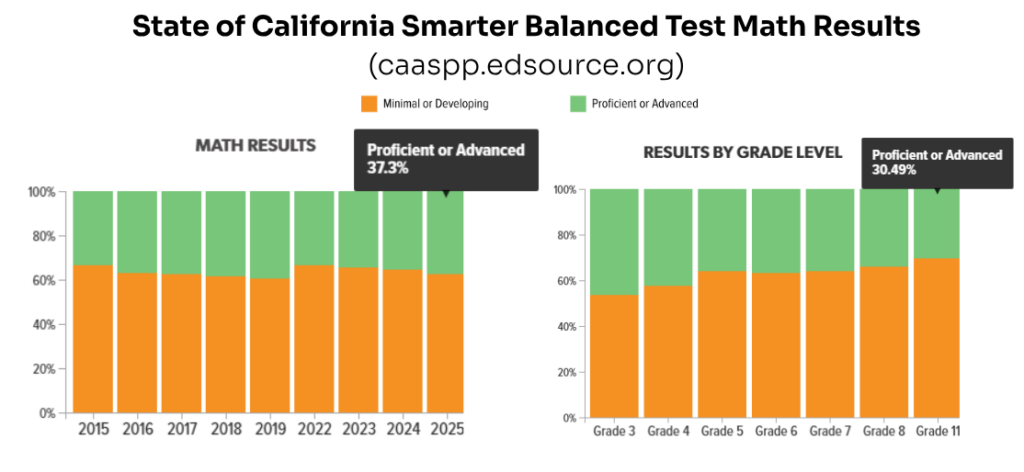
In California, like other states, many districts have adopted adaptive, digital-first platforms as their strategy for closing math gaps. It’s worth noting, however: years into these tools being the default intervention layer, plenty of students are still testing well below grade level in math. The 2025 California state assessment showed only 37.3% of students reaching grade level proficiency targets for mathematics.
With this in mind, SB 1128 and the broader shift toward balancing screen time with teacher-led instruction isn’t a compliance moment to manage around — it’s a chance to ask what would actually close math gaps faster. That means looking for supplemental math support built to identify gaps, target instruction, and monitor whether it worked, in a format that doesn’t depend on a device.
SB 1128…isn’t a compliance moment to manage around — it’s a chance to ask what would actually close math gaps faster.
That’s the standard worth holding any program to right now, ours included: does it do the job as well on paper as it does on a screen?
What to ask when evaluating a program
A few questions worth raising with any math provider, including us:
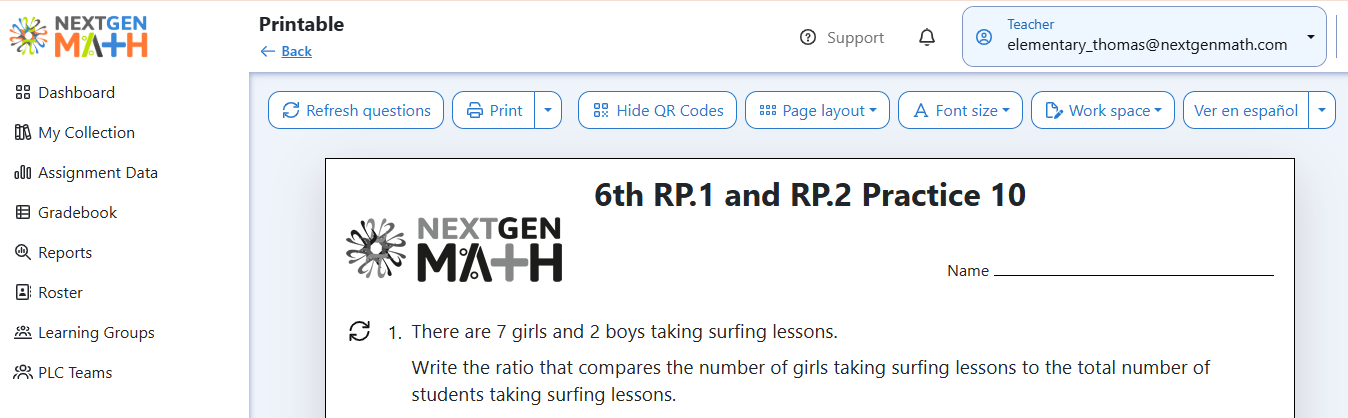
- Does the program work in print without becoming a workaround? Some platforms technically “support” print by letting you export a PDF of digital assignments. That’s different from activities designed to actually be used on paper — with options to add space for student work, adjust font size, change the column layout, include or hide supports, or vary question order per student for a test environment.
- Can it flex between whole-class, small-group, and independent formats? Screen-time limits often apply per-device, per-student. A program that only works as individual, simultaneous device use has fewer options than one built for table groups and shared instruction, too.
- Does the program depend on daily login to work at all? If the program’s value only shows up after weeks of consistent, individual screen time, that’s worth weighing against a model that delivers assessment and instructional value whether the day’s work happens on paper or on a device.
- Does it support the teacher-led cycle, not just the printing? Moving work off screens and onto paper adds real prep time if a teacher is managing it alone. Math programs should close that gap by using student results to point straight to what comes next — which students need reteaching, which are ready for intervention groups, and which are ready to move ahead — without the teacher rebuilding that picture from scratch each time.
Where Next Gen Math fits
This is close to how Next Gen Math was already built, not a pivot in response to the legislation. Our founding belief and strategy has never changed: technology should support teacher expertise, not replace it.
Assessments, activities, and intervention groupings all work in print or digital — whole-class, table groups, independent practice — and next-step recommendations guide teachers’ instructional decisions, rather than replace them. None of this changes as California’s guidance takes shape over the next year.
See how it works in your classrooms. If your district is working through what this shift means for your math intervention plans, we’re happy to talk through where Next Gen Math fits your model — district-led, school-led, or somewhere in between. Schedule a free pilot and put print and digital side by side.